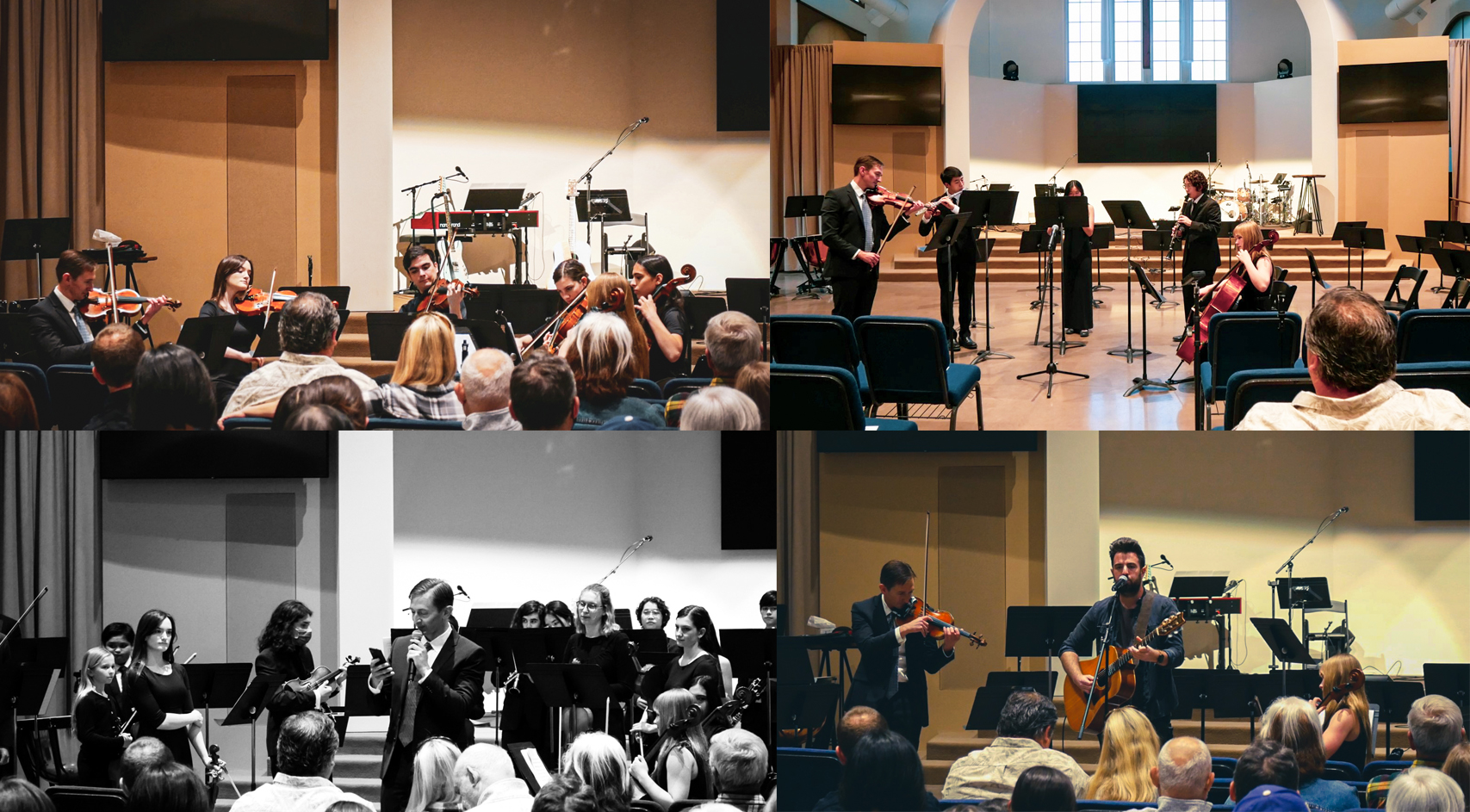
This month’s article is simply the foreword to the Foundations Course. After five years of research, refinement, and development, it is our pleasure to officially release the Foundations Courses in Violin and Piano. The Guitar and Cello editions are expected to be released in late April. Order copies here, or go to our Student Life page.
In thinking of how to introduce a student to this course, I think back to a time when I was sharing a box seat at a theater in Portugal with a good friend who was and is a prominent violinist. We were watching a young violinist (not older than 13) perform the entire Paganini concerto brilliantly, and my friend commented that he shudders at the thought of learning a piece as technically burdensome as the Paganini Concerto. I was momentarily surprised to hear it as I knew he had already performed it at a younger age and had performed many more difficult pieces since.
It did, however, call my attention to an interesting concept: at a young age we are not aware of how difficult our endeavors are. A child learns the entire Paganini concerto not realizing the gravity of the piece, and therefore approaches it without fear. An experienced violinist knows how difficult a piece like that is and approaches it with some anxiety (if not dread).
I often find myself going back and forth in my teaching with how much I should mentally prepare my students for the difficulty of their tasks. I wish there was a blanket answer I could give, but there isn’t. So I will take a moment to jot down a few of the things I discuss as a student leaves the beginner stages and enters the intermediate realm:
Most students (and many teachers) overlook the most challenging aspect of intermediate studies altogether. If we think of the end of the beginner course as a short single sonata movement or a pupil’s concerto movement, and the beginning of the advanced course as a full-length concerto, we see that a student moves from studying a piece that is approximately 2 pages long to a piece that is between 20 and 30 pages long. Developing the ability to handle a work this size is by far the most taxing endeavor of intermediate study.
So each student will be challenged through each of the rounds in this course to become a new musician, and to some extent a new person. At the least that’s what it feels like. Each round will require new practice techniques (both in technique and management), but more importantly will require a new resolve (mentally, physically, and emotionally). After all, if a student continues to learn the comfortable 4-bar section per week, it would take years to learn a single movement of a full-length concerto!
The secondary emphasis of this course is organization and practice technique (not instrumental technique) supported by a solid foundation in musicianship. Practice rotations, complex schedules, and review techniques are employed. In addition, the student will learn to understand their music through the study of composition and analysis, and approach it with a well-balanced and developed mind, ear, and technical skill set. A student with a disorganized mind will not be able to make the transition to the advanced course.
The technique and form elements of this course really are tertiary compared to the mental maturity required to complete it. Still, there will be plenty of focus on instrumental technique through an efficient developmental repertoire system.
Overall, any musician will find this course to be an extremely efficient and well-balanced way to traverse intermediate studies. A student who treats music as an extracurricular activity and has limited practice time will be able to complete the course in approximately four short years. A student who is professional-minded and devotes hours of practice each day will be able to do so much faster.
We look forward with great anticipation to developing a new generation of musicians who perform, compose, understand and analyze their music, and can communicate its complexities.
- Alexander Tseitlin